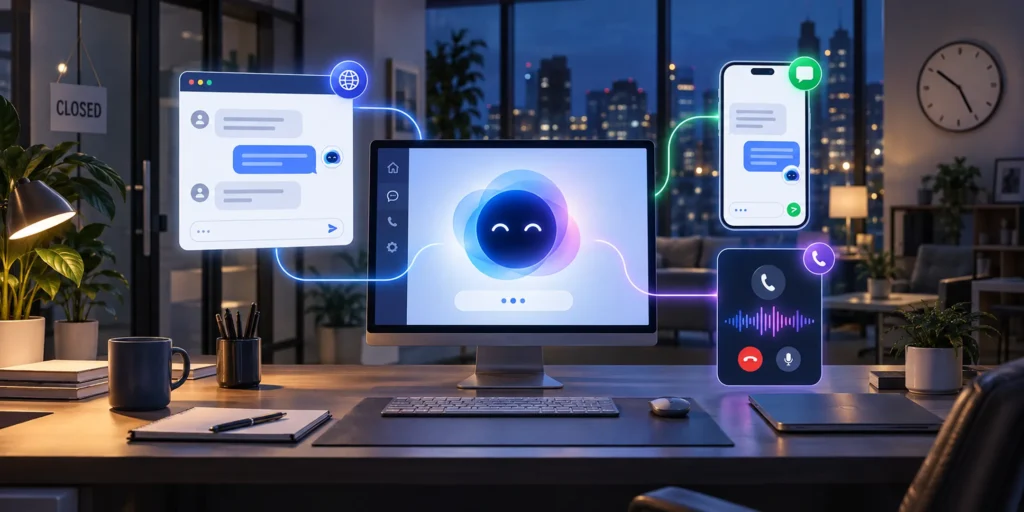
A potential customer visits your website after business hours.
They have a question about your services and want to know whether you can help. They may be ready to schedule an appointment, but nobody is available to respond.
By the time your business follows up the next morning, that person may have already contacted a competitor.
This is one of the problems an AI employee can help solve.
An AI employee can respond to new inquiries, answer common questions, collect information, qualify leads, schedule appointments and maintain follow up. It can work alongside your existing team and continue supporting customers when your business is closed or your employees are unavailable.
It does not replace every human conversation. Instead, it handles the immediate and repetitive parts of customer communication while knowing when a real person should become involved.
What Is an AI Employee?
An AI employee is an artificial intelligence powered assistant that can perform specific customer communication and administrative tasks for a business.
Unlike a traditional automation that sends the same message every time, an AI employee can understand questions, interpret customer responses and continue a conversation based on what the person says.
Depending on how it is configured, an AI employee can:
- Respond to website inquiries
- Answer incoming phone calls
- Reply to text messages
- Answer common customer questions
- Collect names and contact information
- Ask qualifying questions
- Recommend an appropriate next step
- Schedule appointments
- Send reminders
- Follow up with interested leads
- Update customer information inside a CRM
- Transfer conversations to a real person
The goal is not to pretend that artificial intelligence is a human employee. The goal is to give your business a reliable assistant that can respond immediately and handle routine conversations at any time.
How Is an AI Employee Different From a Basic Chatbot?
A basic chatbot usually follows a fixed script.
It may present a list of options such as:
- Learn about our services
- Request a quote
- Book an appointment
- Contact support
If the customer asks something outside those options, the chatbot may not understand the question.
An AI employee is more conversational. It can interpret what someone is asking, use approved information about your business and respond based on the context of the conversation.
For example, a basic chatbot might ask someone to select a service from a menu.
An AI employee could understand a message such as:
“I need help replacing my furnace, but I am not sure which service I should book.”
It could then ask relevant questions, provide general information and guide the person toward the correct appointment.
A basic chatbot follows a predetermined path. An AI employee can adapt the conversation while still operating within the rules established by your business.
How Can AI Respond to New Leads?
Speed matters when someone contacts a business.
A person who completes a form, sends a message or calls your company is expressing interest at that moment. If they have to wait several hours for a response, their attention may move elsewhere.
An AI employee can respond as soon as an inquiry arrives.
The response can acknowledge the customer, answer an initial question and determine what should happen next.
For example, the AI employee may say:
“Thanks for contacting us. I can help you schedule a consultation or answer a few questions about our services. What would you like help with?”
From there, it can continue the conversation based on the customer’s response.
This immediate engagement helps the customer feel acknowledged while giving your business an opportunity to begin the relationship before the lead becomes cold.
Can AI Answer Questions About Your Business?
Yes, but only when it has been given accurate information and clear instructions.
An AI employee can be trained using approved information about your:
- Services
- Service areas
- Business hours
- Appointment availability
- Frequently asked questions
- General pricing information
- Policies
- Consultation process
- Contact information
- Next steps
For example, someone might ask:
“Do you serve customers outside Calgary?”
“Are you open on Saturdays?”
“How long does an appointment usually take?”
“Do you offer free consultations?”
The AI employee can answer these questions using the information supplied by your business.
It should not invent answers or provide information outside its approved knowledge. When it does not have enough information, it should explain that a team member will need to assist.
Keeping the AI employee’s knowledge current is important. If your services, hours, pricing or policies change, the information available to the AI should also be updated.
Can AI Qualify Leads?
Not every inquiry requires the same response.
Some people may be ready to schedule an appointment. Others may be looking for a service your company does not offer. Some may need immediate assistance, while others are researching options for the future.
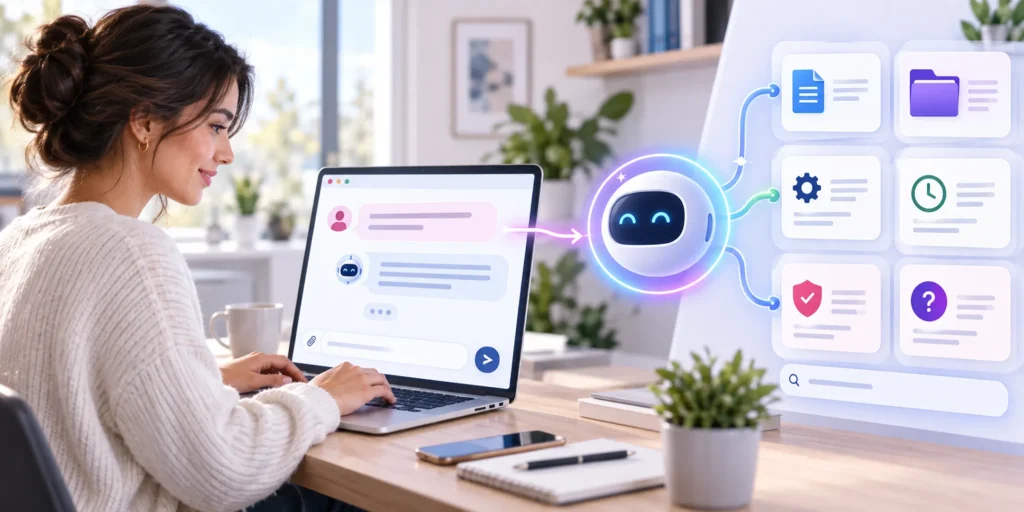
An AI employee can ask a short series of qualifying questions to better understand what the person needs.
Depending on the business, those questions might include:
- Which service are you interested in?
- Where are you located?
- When would you like to get started?
- What problem are you currently experiencing?
- Have you worked with another provider?
- What is the best way to contact you?
- Would you like to schedule a consultation?
The answers can be saved in the customer’s record and used to determine the appropriate next step.
A qualified lead might be invited to schedule an appointment immediately. A lead requiring special attention can be assigned to a team member. An inquiry outside the company’s service area can receive a helpful and respectful response.
AI lead qualification can save time, but it should not become an interrogation. The conversation should remain simple, useful and focused on helping the customer.
Can an AI Employee Book Appointments?
Yes. AI appointment booking is one of the most practical uses of an AI employee.
When connected to your business calendar, the AI can review available appointment times and offer suitable options to the customer.
A typical conversation might look like this:
Customer: I would like to book a consultation.
AI Employee: I can help with that. Would you prefer a morning or afternoon appointment?
Customer: Afternoon.
AI Employee: We currently have availability Tuesday at 2:00 p.m. or Wednesday at 3:30 p.m. Which works better for you?
Once the customer chooses a time, the AI employee can schedule the appointment and send a confirmation.
It can also help with:
- Appointment reminders
- Rescheduling requests
- Cancellation requests
- Directions and preparation instructions
- Follow up after the appointment
This allows customers to book when it is convenient for them, even outside regular business hours.
How Does AI Handle Lead Follow Up?
Many customers do not schedule an appointment during their first conversation.
They may become distracted, need time to consider their options or want to speak with someone else before making a decision.
An AI employee can maintain follow up without requiring your team to remember every lead manually.
For example, it can:
- Follow up after an unanswered inquiry
- Remind someone to complete a booking
- Check whether a customer still needs assistance
- Follow up after an estimate or proposal
- Reconnect with an older lead
- Send appointment confirmations and reminders
- Notify a team member when someone replies
The timing and frequency of these messages should be carefully controlled.
Too many messages can feel intrusive. Helpful follow up should remind the customer that assistance is available without making them feel pressured.
What Happens When a Human Needs to Step In?
An effective AI employee should know its limitations.
Some conversations require human understanding, authority or judgment. These may include:
- Complicated customer complaints
- Sensitive personal situations
- Unusual service requests
- Negotiations
- Detailed technical questions
- Emergency situations
- Questions outside the AI’s approved information
- Customers who request a real person
When this happens, the AI employee should transfer or assign the conversation to the appropriate team member.
It can also provide the employee with a summary of the conversation, including the customer’s contact information, questions and previous responses.
This prevents the customer from having to explain everything again.
The best experience is not AI or people. It is AI and people working together.
The AI handles immediate and repetitive communication, while your employees focus on situations requiring experience, empathy and decision making.
Will Customers Know They Are Speaking With AI?
Businesses should be transparent when customers are communicating with an AI assistant.
The AI employee can introduce itself clearly without making the conversation feel uncomfortable.
For example:
“Hi, I’m Thrive’s AI assistant. I can answer questions, help you schedule an appointment or connect you with our team.”
This sets the correct expectation while immediately explaining how the assistant can help.
Most customers are primarily concerned with receiving a useful and accurate response. If the AI communicates naturally, respects their time and makes it easy to reach a person, the experience can still feel helpful and personal.
Problems arise when businesses attempt to hide the use of AI or make it difficult for customers to reach a real employee.
Transparency builds trust and allows customers to decide how they would like to continue.
Will an AI Employee Sound Robotic?
It does not have to.
An AI employee can be configured to use language that reflects the personality and communication style of your business.
Its responses can be:
- Friendly and conversational
- Professional and direct
- Warm and supportive
- Short and efficient
- Detailed when customers need more information
However, natural communication depends on thoughtful setup.
An AI employee should avoid long generic responses, unnecessary technical language and overly enthusiastic phrases that do not match the conversation.
It should also avoid repeating the same sentence in every interaction.
The best AI communication is clear, helpful and appropriate for the situation. It should feel like a capable assistant, not a machine attempting to imitate a person.
How Does an AI Employee Work With a CRM?
An AI employee becomes much more useful when it is connected to a CRM.
Without a CRM, the AI may be able to answer a question, but the conversation can remain isolated from the rest of the business.
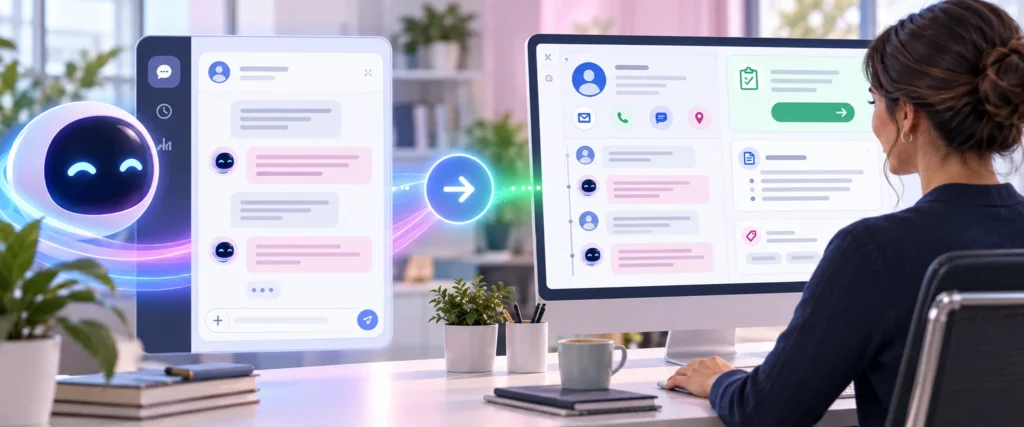
When connected to a CRM, the AI employee can:
- Create a new contact record
- Save the customer’s information
- Record the conversation
- Update an existing customer profile
- Add notes
- Schedule an appointment
- Move an opportunity through a sales pipeline
- Assign the lead to a team member
- Trigger follow up workflows
- Notify employees when attention is required
This creates continuity.
If the customer sends a website message today and calls the business tomorrow, your team can see the previous interaction instead of starting from the beginning.
The CRM becomes the central record, while the AI employee helps manage conversations and complete actions within the system.
What Should Businesses Automate?
AI works best when it handles tasks that are repetitive, predictable and supported by accurate information.
Good opportunities for AI automation include:
- Responding to common questions
- Collecting contact information
- Asking basic qualifying questions
- Scheduling appointments
- Sending confirmations
- Sending appointment reminders
- Following up with new leads
- Routing inquiries to the correct employee
- Providing business hours and service information
- Requesting additional details before a consultation
These tasks happen frequently and usually follow a consistent process.
Automating them can improve response times while reducing the administrative workload on your team.
What Should Businesses Not Automate?
Not every customer interaction should be handled entirely by AI.
Businesses should be careful about automating:
- Serious customer complaints
- Sensitive financial discussions
- Legal or medical advice
- Emergency situations
- Complex technical recommendations
- Final pricing negotiations
- Decisions requiring professional judgment
- Conversations involving personal hardship
- Any commitment the AI is not authorized to make
AI should support your business rules, not make important decisions without appropriate oversight.
A simple principle is useful:
Automate the routine. Escalate the complex. Keep people responsible for judgment.
Is an AI Employee Available 24/7?
An AI employee can remain available around the clock because it does not depend on regular office hours.
It can respond during evenings, weekends and holidays, helping customers when your employees are unavailable.
This does not mean every issue will be completely resolved at any hour.
The AI can answer approved questions, collect information, schedule appointments and explain when a team member will be available. If the situation requires human attention, it can record the details and notify the appropriate person.
For many businesses, the greatest benefit is not replacing daytime staff. It is covering the periods when nobody would otherwise respond.
A lead arriving at 10:30 p.m. can receive help immediately instead of waiting until the next morning.
Which Businesses Can Benefit From an AI Employee?
An AI employee can be useful for businesses that regularly receive inquiries, schedule appointments or answer similar questions.
Examples include:
- Home service companies
- Professional service firms
- Medical and wellness clinics
- Real estate businesses
- Automotive businesses
- Restaurants and hospitality companies
- Fitness centres
- Legal offices
- Accounting firms
- Contractors and trades
- Marketing agencies
- Property management companies
The technology is most valuable when delayed responses, missed calls or inconsistent follow up are causing legitimate opportunities to be lost.
A business receiving only a few highly specialized inquiries may not need extensive AI automation. A business receiving frequent calls, messages and appointment requests may benefit significantly.
How Thrive’s AI Employee Works Inside One Connected System
Thrive’s AI Employee is designed to work within the complete Thrive system.
It is not a separate chatbot that holds isolated conversations. It connects customer communication with your lead capture, CRM, appointments, sales pipeline and automated follow up.
The complete journey can work like this:
Generate: A potential customer discovers your business through your website, search results, advertising, social media or another marketing channel.
Capture: The customer calls, sends a message, completes a form or begins a website conversation.
Respond: The AI Employee answers immediately, provides approved information and learns what the customer needs.
Qualify: It asks relevant questions and records the answers inside the customer’s profile.
Book: It reviews your available calendar and schedules an appointment.
Convert: The opportunity is organized inside your sales pipeline so your team can see exactly where it stands.
Automate: Confirmations, reminders and follow up continue automatically based on the customer’s activity.
Escalate: When human assistance is needed, the conversation and customer information are transferred to the appropriate team member.
Every interaction remains connected to one customer record.
This gives your business one complete system for generating opportunities, capturing inquiries, managing conversations, converting leads and automating routine work.
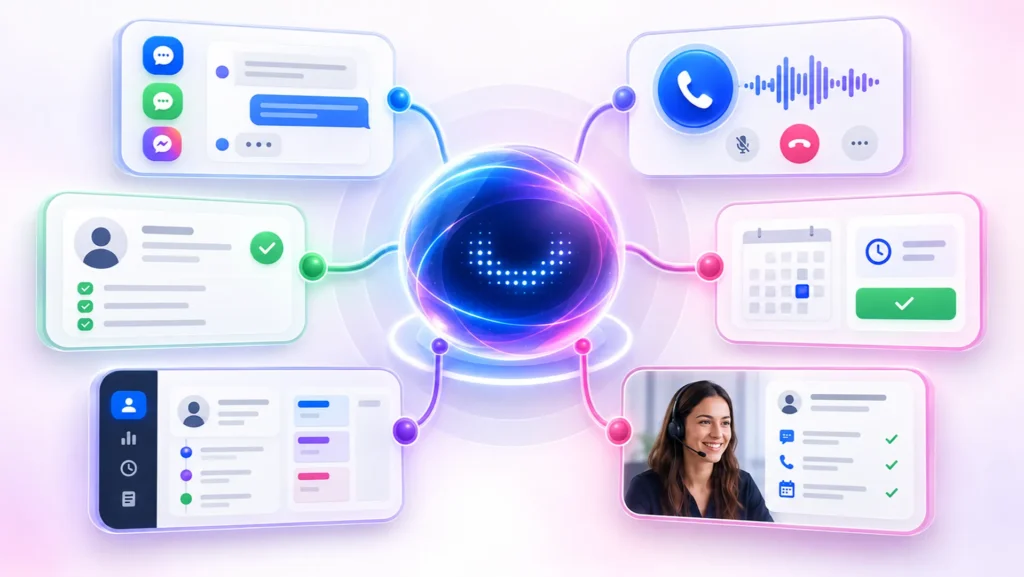
Meet Thrive’s AI Employee
Give every new lead an immediate response, answer common questions, qualify opportunities, book appointments and maintain follow up around the clock.
Connect every conversation to one complete system for lead capture, conversion and automation.